
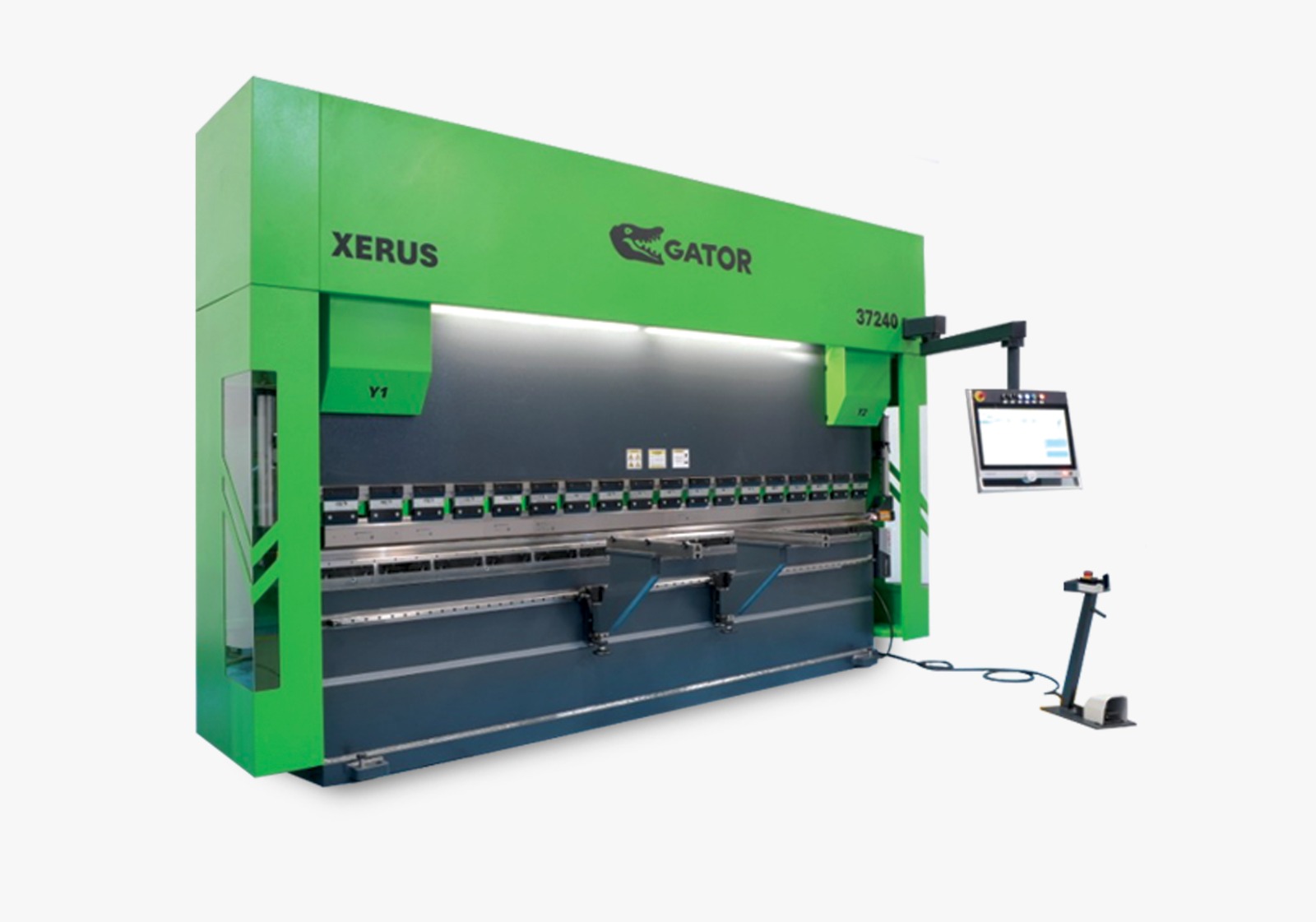
Press Brakes
The CNC press brake is one of the most important machines in a modern metal fabrication shop. It determines how accurately a shop can bend sheet metal, form plate, repeat complex parts and maintain production consistency across daily jobs.

XERUS CNC Hydraulic Press Brakes
About Press Brakes
Gator FabTech supplies American-engineered CNC press brake solutions built for precision, power and long-term shop-floor reliability. Whether your production requires heavy-duty hydraulic forming, efficient hybrid performance, advanced CNC crowning or a more capable backgauge system, the right press brake should be selected around your material, part geometry, tonnage requirements and throughput goals.
This guide explains what buyers should compare before investing in a CNC press brake, how hydraulic and hybrid systems differ, why frame rigidity and crowning matter, and how Gator FabTech helps fabrication shops choose a machine that supports accuracy, uptime and long-term productivity.
Precision Bending
CNC controls, crowning and backgauge systems help maintain repeatable bend angles and reduce setup errors.
Industrial Power
Hydraulic and hybrid systems are designed to support demanding bending applications, thicker materials and production workflows.
Long-Term Support
Tooling, parts, service planning and financing support are key factors when evaluating the true value of a press brake.
What Is a CNC Press Brake?
A CNC press brake is a metal bending machine that uses a punch and die to form sheet metal or plate into precise angles and shapes. The CNC system controls key variables such as ram movement, backgauge positioning, bend sequence, crowning compensation and repeatability.
For fabrication shops, the press brake is not just another machine on the floor. It directly affects part quality, labor efficiency, rework rates, production speed and the range of jobs the shop can accept.
Choosing the right machine requires more than comparing price. Buyers should evaluate tonnage, bending length, frame construction, drive system, CNC control, backgauge axis configuration, tooling compatibility, maintenance requirements and support after installation.
Which Press Brake Drive System Is Right for Your Shop?
The drive system determines how the press brake delivers force, how it feels to the operator, how efficiently it runs and how well it fits your production environment. Hydraulic and hybrid press brakes are commonly selected for industrial fabrication because they provide strong forming capability and reliable shop-floor performance.
| Drive Type | Key Characteristics | Best For |
|---|---|---|
| Hydraulic Press Brakes | High tonnage capacity, strong forming force, robust construction and proven industrial performance. | Heavy plate forming, general fabrication, job shops and high-force bending applications. |
| Hybrid Press Brakes | Combines hydraulic power with improved speed, responsiveness and operating efficiency. | High-performance shops that need a balance of power, speed, precision and efficiency. |
For buyers, the best choice depends on the parts being formed, material thickness, required tolerance, expected production volume and the operator experience available inside the shop.
Gator FabTech CNC Press Brake Series
Gator FabTech’s press brake lineup is designed for fabrication shops that need accuracy, machine rigidity, dependable forming power and support beyond the initial purchase. The XERUS Series is built for shops that want a capable CNC hydraulic or hybrid press brake solution for demanding bending workflows.
XERUS Series CNC Press Brakes
The XERUS Series is positioned for fabrication teams that require advanced control, reliable forming performance and the ability to handle complex bending workflows with greater confidence.
It is a strong fit for shops comparing machine capacity, frame stability, backgauge flexibility, CNC crowning, hydraulic cylinder durability and long-term production uptime.
Before selecting a press brake, buyers should share material type, maximum thickness, bending length, target part profiles, daily production requirements and tooling needs. These details make it possible to recommend a configuration that fits real production conditions.
What Should Buyers Compare Before Choosing a Press Brake?
A press brake should be matched to the shop’s actual work, not selected only by tonnage or price. The most important buying factors include forming force, usable bending length, frame design, control system, backgauge configuration, crowning method and tooling compatibility.
| Selection Factor | Why It Matters | What to Evaluate |
|---|---|---|
| Tonnage | Determines the forming force available for thicker, harder or wider materials. | Material type, thickness, bend radius, die opening and required forming force. |
| Bending Length | Controls the maximum part width the machine can form. | Current part sizes, future work, long flanges and available shop space. |
| CNC Control | Improves programming, bend sequencing, repeatability and operator consistency. | Control interface, ease of use, program storage and workflow speed. |
| Backgauge System | Supports accurate flange dimensions and complex part positioning. | Axis count, finger movement, repeatability and part complexity. |
| Crowning | Helps compensate for machine deflection during bending. | Manual, CNC or automatic crowning depending on accuracy requirements. |
| Tooling | Affects bend quality, setup time and the range of parts the machine can produce. | Punches, dies, segmented tooling, clamping and future tooling requirements. |
Engineered for Zero-Deflection Accuracy
In precision bending, the frame is just as important as the controller. Even a powerful machine can produce inconsistent angles if frame deflection is not properly managed.
Gator FabTech press brake engineering focuses on reducing the impact of ram and bed deflection so shops can maintain better angle consistency across the full bend length.
- Automatic CNC Crowning: Helps compensate for deflection by adjusting the lower bed, supporting a more consistent bend angle across the part.
- Stress-Relieved Frame Design: Designed to minimize deformation and support long-term structural stability under load.
- Large-Radius Tensile Points: Helps reduce stress concentration and potential welding crack points in critical frame areas.
- Bolted Hydraulic Cylinder Design: Supports improved leveling, stability and serviceability compared with less accessible designs.
Are Gator FabTech Hydraulic Cylinders Durable?
Yes. Gator FabTech hydraulic cylinders are made from SAE 1040 forged material and honed to a surface quality of 2 microns. This precision helps minimize friction and wear, supporting long-term durability in demanding fabrication environments.
Configuration Guide: Selecting Your Backgauge Axis
The backgauge is one of the most important systems for bending accuracy. It controls the position of the material and helps determine flange dimensions, repeatability and setup flexibility. The more complex the part, the more important backgauge axis selection becomes.
| Axis Configuration | Capability | Best For |
|---|---|---|
| 2-Axis: X, R | Depth and height adjustment for standard positioning. | Standard industrial bends, simpler part profiles and routine forming jobs. |
| 4-Axis: X, R, Z1, Z2 | Independent finger movement for more flexible part positioning. | Complex parts, tapered bends, multi-station setups and higher-mix production. |
| 6-Axis: X, R, Z1, Z2, X5, X6 | Maximum independent finger flexibility and advanced positioning control. | Highly complex parts, advanced bending programs and automated bending cells. |
Shops producing simple, repeatable bends may not need the same backgauge capability as shops handling complex multi-bend parts. Choosing the correct axis configuration helps avoid overbuying while still protecting future production flexibility.
Common Applications for CNC Press Brakes
CNC press brakes are used across a wide range of metal fabrication environments. The right configuration depends on material type, part size, tolerance requirements and production volume.
General Fabrication
Brackets, panels, enclosures, covers, frames and formed components for job shops and manufacturers.
Heavy Plate Forming
Higher-tonnage bending applications involving thicker material, longer parts and stronger forming requirements.
Structural Steel Support
Forming and bending support for structural fabrication workflows, frames, plates and industrial components.
Custom Manufacturing
High-mix production environments where flexible programming, repeatable setup and tooling options are important.
Press Brake Tooling, Parts and Support
A press brake purchase should not be evaluated by machine specifications alone. Tooling, parts availability, service planning and operator workflow have a direct impact on production quality and uptime.
Punches, dies, segmented tooling, clamping systems and replacement components all influence setup time, bend quality and the range of parts a shop can produce. For this reason, tooling should be considered early in the machine selection process.
To explore related options, visit the
Press Brake Tooling
section or contact Gator FabTech for guidance on tooling and support requirements.
Maintenance and Longevity Considerations
Long-term press brake performance depends on machine design, component quality and proper maintenance. Shops should consider how the machine protects key moving parts, reduces internal wear and resists corrosion over time.
- Dust Protection: Backgauge systems with scraping-type bearings help reduce dust accumulation in linear guides.
- Low-Friction Operation: Adjustable top tray slides and hard chrome-plated pistons help reduce internal wear.
- Corrosion Resistance: Coated surfaces help protect the machine from environmental wear and support longer service life.
- Service Planning: Parts access, maintenance routines and support availability should be reviewed before purchase.
Why Fabrication Shops Choose Gator FabTech
Gator FabTech helps fabrication shops evaluate equipment from a practical production perspective. The goal is not only to provide a machine, but to help buyers select the right configuration for their workload, material range, accuracy expectations and long-term growth.
American-Engineered Equipment
Built around practical fabrication needs, production efficiency and long-term reliability.
Application-Based Guidance
Machine recommendations are based on material, part size, tonnage, tooling and production goals.
Tooling and Parts Mindset
Support considerations include tooling, replacement parts, uptime and long-term service planning.
Quote and Financing Support
Qualified buyers can discuss machine configuration, budget planning and financing options.
Request a CNC Press Brake Quote
If you are comparing CNC press brakes, share your material type, thickness, bending length, production volume, backgauge needs and tooling requirements. Gator FabTech can help you evaluate the right press brake configuration for your shop.
CNC Press Brake FAQ
What size CNC press brake do I need?
The right size depends on material type, thickness, bend length, bend radius, die opening and production goals. Tonnage and bending length should be selected around the parts your shop actually produces.
Is a hydraulic press brake better for heavy fabrication?
Hydraulic press brakes are commonly selected for heavy-duty forming because they provide strong forming force and broad industrial flexibility. The best choice still depends on your material, tolerance needs and production environment.
Why is CNC crowning important on a press brake?
CNC crowning helps compensate for deflection during bending. This supports more consistent bend angles across the length of the part, especially on longer bends and higher-tonnage applications.
What backgauge axis configuration should I choose?
Standard parts may only require a simpler axis configuration, while complex parts, tapered bends and multi-station setups may benefit from 4-axis or 6-axis backgauge capability.
Can Gator FabTech help with tooling and support?
Yes. Gator FabTech can help buyers evaluate press brake tooling, parts, service requirements, financing options and related support needs for long-term production reliability.
{ "@context": "https://schema.org", "@type": "BreadcrumbList", "@id": "https://www.gatorfabtech.com/product-category/press-brakes/#breadcrumb", "itemListElement": [ { "@type": "ListItem", "position": 1, "name": "Home", "item": "https://www.gatorfabtech.com/" }, { "@type": "ListItem", "position": 2, "name": "Products", "item": "https://www.gatorfabtech.com/products/" }, { "@type": "ListItem", "position": 3, "name": "Press Brakes", "item": "https://www.gatorfabtech.com/product-category/press-brakes/" } ] }
Need Help Choosing the Right Press Brakes?
Our experts are here to help you find the perfect solution for your specific needs.