
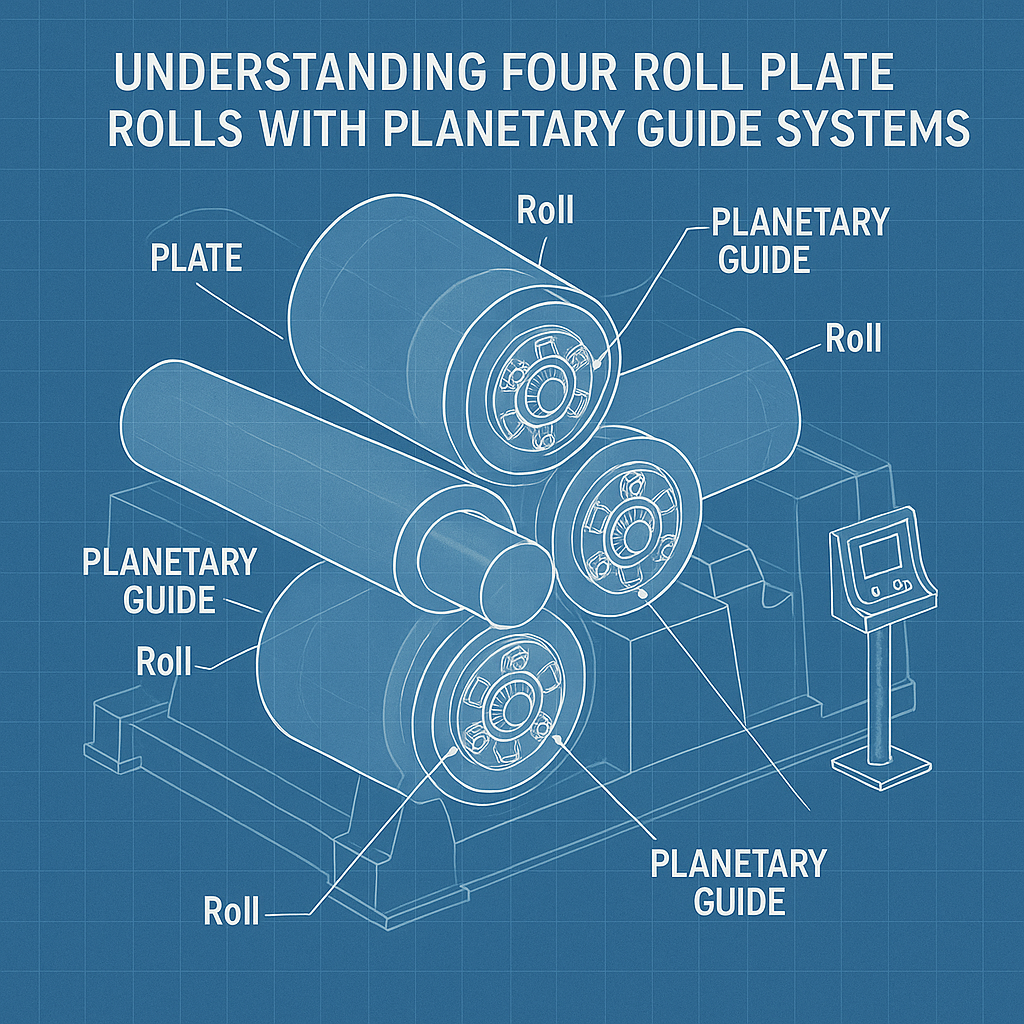
A 4-roll plate roll uses an upper roll, a lower roll, and two side rolls to control the plate during pre-bending and rolling. The architecture can reduce handling and support repeatable cylinder or curved-part production, but machine capacity must be evaluated against material strength, plate width, thickness, target diameter, pre-bending requirement, and support needs.
How a 4-Roll Plate Roll Works
- The plate is positioned between the upper and lower rolls.
- The lower roll clamps the plate so it can be controlled during the forming sequence.
- A side roll moves to pre-bend one edge.
- The plate is fed and the second side roll supports the rolling sequence.
- The machine forms the target cylinder or curve through controlled roll movement.
The exact sequence, controls, and permissible geometry depend on the machine. Operators should follow the manufacturer’s procedure and verify the setup with the selected material.
Why Shops Consider Four-Roll Machines
- Plate clamping can improve material control during the rolling sequence.
- Pre-bending and rolling can be organized within one machine workflow.
- CNC or NC control may support repeat programs and operator consistency.
- Side and overhead supports may reduce handling difficulty on larger diameters.
- The architecture can be integrated into loading, fit-up, tack welding, and downstream welding plans.
Key Selection Variables
| Variable | Why It Matters | What to Provide |
|---|---|---|
| Material strength | Stronger material requires more forming force than the same thickness of a lower-strength material. | Grade, yield strength, and condition. |
| Plate thickness and width | Capacity changes with working width, pre-bending, and material properties. | Routine and maximum sizes. |
| Target inside diameter | Small diameters may require different roll geometry and machine capacity. | Finished diameter, tolerance, and shell length. |
| Pre-bending | Edge bending affects flat-end length and fit-up. | Required pre-bend thickness and acceptable flat. |
| Cone or variable-radius work | Special geometry may require controls, attachments, and operator experience. | Drawings, cone angle, and minimum/maximum diameters. |
| Part support | Large shells can require side or overhead support. | Part weight, diameter, handling method, and floor space. |
Linear-Guide and Planetary-Guide Options
Gator FabTech’s published four-roll lineup includes a G4L Linear Guide product and the G4P and G4P-ECO Planetary Guide product pages. Guide terminology alone should not decide the purchase. Compare the model-specific capacity table, roll geometry, controls, maintenance access, support options, and the work the machine must perform.
When a 3-Roll Machine May Still Be Appropriate
A four-roll machine is not automatically the correct choice for every shop. Production volume, operator method, budget, geometry, required pre-bending, and existing handling equipment can make a three-roll configuration practical. Read the 3-roll vs 4-roll selection guide and the initial-pinch 3-roll guide before comparing quotations.
Gator FabTech Plate Roll Structure
Start with the Plate Rolls hub and then use the Hydraulic 4-Roll category for the active model group. Confirm every technical value on the individual product page and current quotation.
Quote Checklist
- Material grade and yield strength.
- Plate thickness and working width.
- Target inside diameter and tolerance.
- Pre-bending and acceptable flat-end requirements.
- Cone, multi-radius, or special-geometry drawings.
- Daily volume and repeat-program requirements.
- Side supports, overhead support, loading, unloading, and crane limitations.
- Control, safety, installation, training, and service requirements.
Send drawings and plate data through the Gator FabTech contact page. For budget planning, review equipment financing separately from the machine-selection decision.