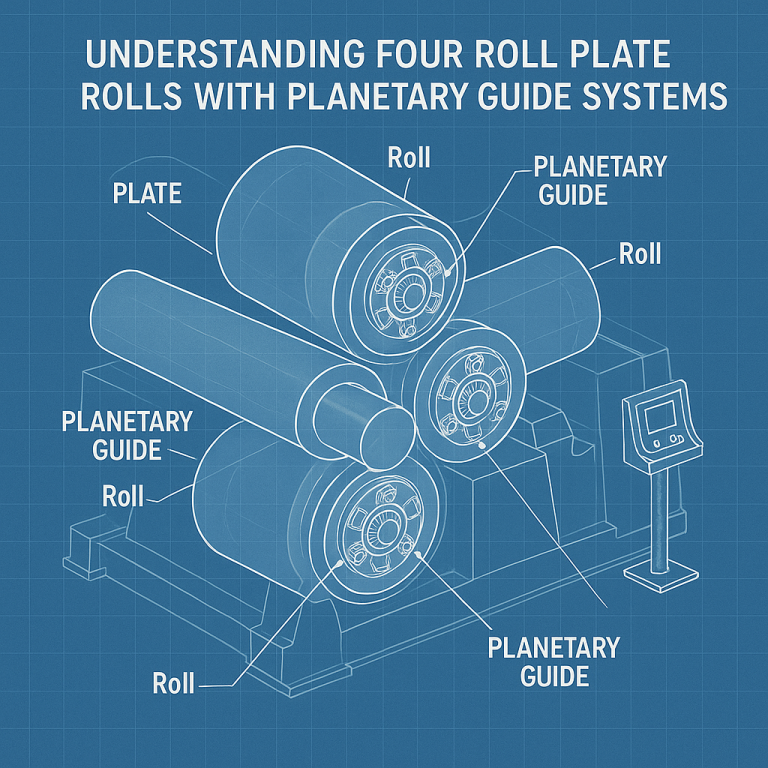
The choice between a 3-roll and 4-roll plate rolling machine depends on the material, geometry, pre-bending requirement, handling method, production volume, and operator workflow. Roll count alone does not determine capacity or finished-part quality. The selected model’s capacity table and the actual application must be reviewed together.
3-Roll vs 4-Roll Overview
| Factor | 3-Roll Machine | 4-Roll Machine |
|---|---|---|
| Material control | Depends on the specific initial-pinch, double-pinch, or variable-axis design. | Upper and lower rolls can clamp the plate while side rolls control the forming sequence. |
| Pre-bending | Method and repositioning requirements vary by architecture. | Often evaluated for controlled pre-bending within one clamped workflow. |
| Handling | May be practical for general work, but part movement must be reviewed. | Can reduce some repositioning; large shells may still need side or overhead support. |
| Control | Mechanical, hydraulic, NC, and CNC configurations exist. | Hydraulic, NC, and CNC configurations are common in the Gator published group. |
| Decision basis | Routine part mix, budget, geometry, operator method, and required capacity. | Repeat workflow, pre-bending, material control, automation, and handling plan. |
Capacity Is More Than Thickness
Plate width, material yield strength, pre-bending thickness, target diameter, top-roll diameter, support method, and operating condition all affect capacity. A “maximum thickness” value without the corresponding width, material basis, and diameter can be misleading.
Questions That Determine the Architecture
- What are the material grades and yield strengths?
- What thickness and working width are processed routinely?
- What is the smallest required inside diameter?
- How much flat is acceptable after pre-bending?
- Are cones, variable radii, or multiple diameters required?
- How often are parts repeated?
- What crane, side-support, overhead-support, and unloading resources are available?
- How will the shell move to fit-up and welding?
Gator FabTech Plate Roll Families
The Plate Rolls hub separates the Hydraulic 4-Roll and Initial-Pinch 3-Roll categories.
Published four-roll product pages include G4L Linear Guide, G4P Planetary Guide, and G4P-ECO Planetary Guide. The published initial-pinch group includes G3LA-H, G3LB-H, G3LA-M Series A, and G3LB-M Series B.
Use the Architecture-Specific Guides
Read 4-Roll Plate Rolls: Pre-Bending, Control and Selection for the four-roll workflow. Read Initial-Pinch 3-Roll Plate Rolls: Applications and Selection for the initial-pinch workflow.
Total Cost and Production Fit
Compare machine price together with tooling, support devices, material handling, installation, foundation, controls, training, maintenance, spare parts, setup time, scrap, rework, and utilization. A lower initial price may not be the lowest production cost, while a more automated machine may not be justified without repeat work.
Quote Package
- Part drawings and rolled geometry.
- Material, grade, yield strength, thickness, and width.
- Target diameter, tolerance, and acceptable flat.
- Pre-bending, cone, and special-profile requirements.
- Production volume and repeat programs.
- Handling, support, crane, and floor-space plan.
- Control, installation, training, and service requirements.
Send the package through the Gator FabTech contact page and review equipment financing only after the machine configuration is defined.